

Learning to Weave with Cattails in Ukraine and Poland
I have been itching to share about my cattail weaving mentorship moments ever since I finished sharing about the straw weaving (which was wonderful and extensive!).
There is something about cattails that I love so much, in a different way from straw.
Pani Evheniya put it like this: "working with straw is like weaving with linen; working with cattails is like working with wool". As a loomweaver who's worked with both linen and wool, I knew exactly what she meant, and I immediately loved the analogy! :)
The strength and shine of straw (especially rye) in comparison to the matte, subtle, squishy and soft cattail, makes straw feel rich and perhaps superior, but cattail for all its homeliness is a wonderfu material, very accessible and easy on the hands.
Having grown up in southern Ontario and spent a lot of time out in the wilds, foraging and crafting, I have fond memories as a child, discovering I could harvest our local cattails and weave mats with them.
At the time, I didn’t know how to twine the edges, and I remember sewing them with needle and thread (which wasn’t very ideal). All these years later, I have become oh so curious about cattail weaving again. And about finding cattail weaving teachers!
I now live in the Ottawa valley, also replete with lakes and wetlands and all the cattails one could hope for. Partly my curiosity started to grow more as I encountered a rush weaver in England three years ago, and experienced a most serendipitous connection, witnessing her first rush harvest of the season, and assisting with the drying, sorting, and grading of the rush. I wove my first tiny rush basket base/coaster by the fireside beneath the stars, the night before a flight to Poland, and I was hooked. (I carried spare rushes with me to weave another tiny basket while in Poland, but finished it in Lviv :)
Coming home, I didn’t see those kinds of rushes growing anywhere*… and started to think of cattails…
Another reason I was starting to feel the need to know how to work with cattails was this awesome woven hat I found at my parents’ house, which I started wearing about, somewhat ironically, because it’s a bit clunky and felt silly; it was so practical and I got so many compliments and questions about it that I eventually grew very fond of wearing it. Many people asked me what it was made of, and where it was from. I realised I knew it was cattail, and likely from Ukraine or Poland… and remembered a woven bag I had from the Lviv market that was made from the same materials… suddenly this became more personal… I had to learn more.
Lucky for me, I made some great connections on my trip.
Firstly, I had the great pleasure of learning to make a beginner cattail basket (woven around a frame) with Lucija at Serfenta in Cieszyn, Silesia, Poland. Upon my return to Ukraine, to the Volyn region, I had the good fortune of being introduced to pani Evheniia in Volodymyr- Volynsk, one of the very few basket weavers who works with cattail.
*upon returning home, I have since spotted rushes around, but they are much smaller and fewer in number
Serfenta
I first learned to make spiral and coil technique baskets from straw with Paulina at Serfenta (which I shared in a blog post in April while I was there),

and then Lucija introduced me to working with cattails to form a rectangular basket, built around a wooden block ‘frame”.
She shared a little slideshow with information about the carriers of this tradition, how Serfenta collected the knowledge from them, and how the harvest is done. (I was surprised to hear they harvest it dry in the dead of winter on the drained/frozen lakes!)
A trimmed bunch of cattail bottoms:

There were many fine examples of woven cattails (and rushes) to see in their studio display:
Then we got our hands to preparing the material.

The dry stalks are hosed down rather than soaked, then kept moist. Then the leaves are gently separated (they grow in little layered bundles), and sorted. I was surprised to learn that it’s mostly the very bottom of the leaf that is used mostly (the thickest spongiest part). They are trimmed to be of equal width, and the innermost leaves, which are round, are saved for the twining around the edges, and for weaving handles.

Surprisingly this took a long time (it didn't help that I finally had a serious crash after the dance festival and 5 days of hardly sleeping ;)), but as with most things, the prep always takes a long time, as does getting the hang of working with a new material.
We had a lovely lunch break at the local "milk bar" (cheap good local fare).

Then, back to work.
Lucija demonstrating the first steps:
Then starting to build the shape on the block:

Getting into it:

Pounding on the cattails after weaving, to flatten and even out the material:

A very very tired me, 3rd day of weaving and almost finished the final touches on the edging of the basket!

I absolutely loved it! Thank you, Lucija (and Paulina! :)

On to Ukraine....
I returned to Volyn region, after a brief stint in Lviv, and a quick trip to Kosiv, Ivano-Frankivsk oblast (with its famous bazaar).
Volodymyr-Volynsk
While in Volyn (Northwestern region), Ukraine, I spent most of my time studying straw plaiting and being mentored by master Maria Kravchuk. I asked if there were any cattail weavers around, and pani Maria connected me with pani Evhenia Romashchuk, from the same region.
I took a bus to Volodymyr, a city about a millennia old (founded by Volodymyr the Great around 1000 CE!), where pani Evhenia was now living. In fact, our meeting was delayed, because she was in the midst of moving (she had worked and lived in Lviv, and now upon retirement, was moving back to her family home in the centre of Volodymyr). In her business of moving and renovating her house, she obliged a visit, and a proper master class.
Pani Evheniia met me at the bus stop, and walked me through the park, where the remains of the original castle/fortified walls were, and the first peonies of the season happened to be blooming...
by the wetland where she harvests cattails and rushes, and we wound our way back to her house through cobblestone streets past the old monastery in the centre of the old town.

The weather was very beautiful, and spring had arrived in historic Volodymyr- Volynsky. I loved seeing all the spring blooms and the old architecture.
When we arrived at pani Evheniya Romashchuk's home, we were met by her niece, who was joining us for the master class, and has started to be mentored by her aunt. The passing on of knowledge runs in the family.
Pani Evhenia is a generational weaver. She learned from her father, who learned from his father.
She shared about how he learned to make a great deal of things in his childhood with his family in exile under Soviet occupation, and how he turned to basketmaking in earnest much later, in his retirement. He worked tirelessly in his studio every day producing a great number of large and finely woven cattail and straw baskets, faithful to the craft. He was given honorary membership in the National Union of Artists.

Here he is pictured with his creations and his signature straw hat and cigarette. The photo was snapped on a folklore expedition documenting local crafts and craftspeople.
Pani Evhenia shared that she wasn't particularly drawn to the work her father was doing as a child, but one day he showed her how to make a simple plait, and from then on she kept working at it to hone her skill. In her later years she started to also weave in earnest, making straw baskets and hats and travelling to sell at the folk markets in Poland (including the Jagiellonski Fair)and markts in Lviv and Kyiv. She found a small plot of land to rent, to sow rye for straw, and also harvests cattails, rushes and willow locally. She has no children but is passing on the knowledge to her niece. After a long career in art & design (she was a designer for a perfume company), in her retirement she has turned to craft.
I felt so fortunate to have found such a kindred spirit in pani Evhenia. She showed me her beautiful collection of baskets and hats, we drank tea, shared stories of family & lineage, the war, immigration and diaspora...folk healing... then we got to work :)


The cattails had already been soaked and kept moist. Pani Evheniya showed me how to trim them to equal width for plaiting, and trimmed them for me as we went. Her niece waxed hemp thread for me to sew with.
I was shown how to start a 5 strand plait, and after plaiting for a while, with warm encouraging coaching along the way, we stopped to see the next part of the process.

After having plaited a long length, we started to wrap the braid for sewing. Same technique for starting a hat or basket.
An example of a big basket you can make with this type of plaiting:

In our morning together I got to finish a little coaster sized piece.
Very small looking next to all the master's creations, but a good beginning.
(The trimming of the cattails to have a nice uniform bunch for consistent width is a big part of the prep)
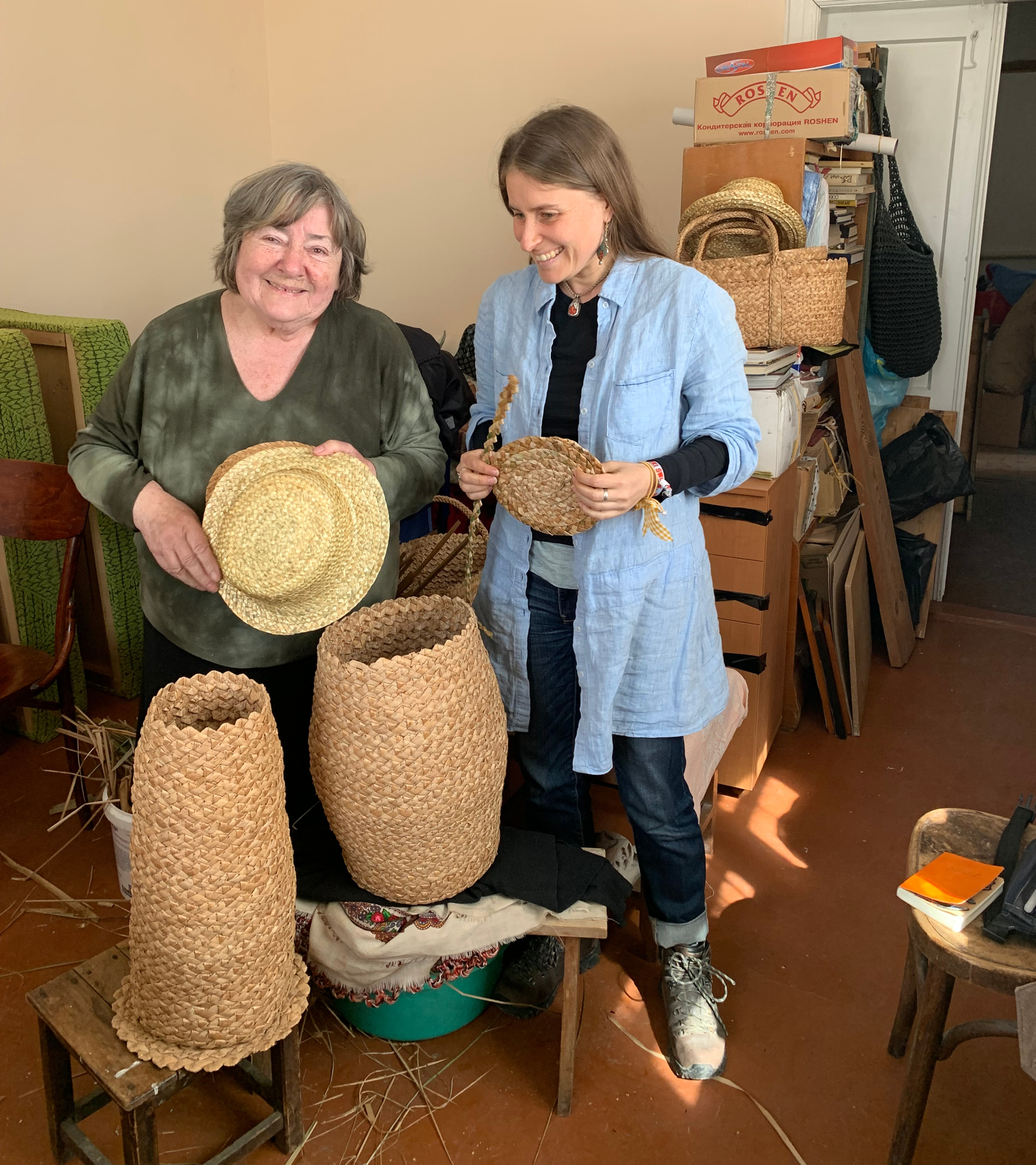
Posing for posterity :)

After lunch, we sat and chatted, and admired some of the other creations in the house.


I had such a wonderful time, and had no idea that during our time together there had been a huge region-wide missile attack and that the whole country had been under air raids all day. My host, pani Maria was in Lutsk for the day, and the very centre of Lutsk where she was was hit and in lockdown, but she managed to get out just before that, and catch a bus home. I watched 'the news' when I got home. All across Volyn, civilian areas were hit. .. the war was much closer that day, yet I was fortunate. We had been blissfully weaving.

Thank you to my teachers! Dyakuyu! Dziękuję


Comments